
The word mies comes from the Latin term messis , which can be translated as harvest.
To be able to harvest, you have to analyze the land, treat it, sow it, take care of it and then, afterwards, collect what has been harvested.
This verb linked to the countryside: to harvest, perfectly represents everything we experienced in thirteen projects linked to the rural world within the MIES program, organized by AlmaNatura in collaboration with Ashoka and Google.org
Two weeks ago we 'landed' in Arroyomolinos de León (Huelva), AlmaNatura's main headquarters. What happened there deserves to be recounted calmly and carefully, because you rarely get to feel the energy, passion, and feeling that a group of people put into what they do.
The beginning of the journey
Late November 2023. While returning from a facilitation session in Ordesa, I received a call on my mobile phone. It was from Sofia Quintanero (project manager at AlmaNatura). She was calling to propose the participation of Pueblos Remotos in a 'training' program called: MIES Program.
At that moment, walking quite quickly through Atocha station, in order to catch a plane back to Tenerife, my head wasn't in any other place: we still had to launch PR ULL – Garachico , close out 2023 , prepare for 2024 and we/I was coming from a pretty 'busy' season.
Thank goodness there's such a thing as 'calm' and that in a moment of reflection we managed to find a way to attend this training, because missing it would have meant missing out on stories that 'deserve to be told' and a group of people with 'incredible stories behind them'
I hope this 'brief' introduction serves as food for thought for you, so that you carefully consider whether to say 'YES' or 'NO' to a project after having calmly thought it through, and not because of the situation you are experiencing at the moment it is proposed to you (especially if that situation involves a certain level of stress)
The sowing (knowing the projects involved)
Going back to the beginning: analyze the terrain, treat it, and sow it.
In these terms, the curiosity initially arose from the working methodology that was going to be used: EXWEDO .
Among the many things I've done (and continue to do) in my life, training has always been (and is) one of the most important, so learning about new training methods is something that really appeals to me. Furthermore, the fact that the Terra da Auga (which I'll introduce to you a little later) was behind that training only increased my curiosity. Without a doubt, this was one of the reasons I decided to participate in the program.
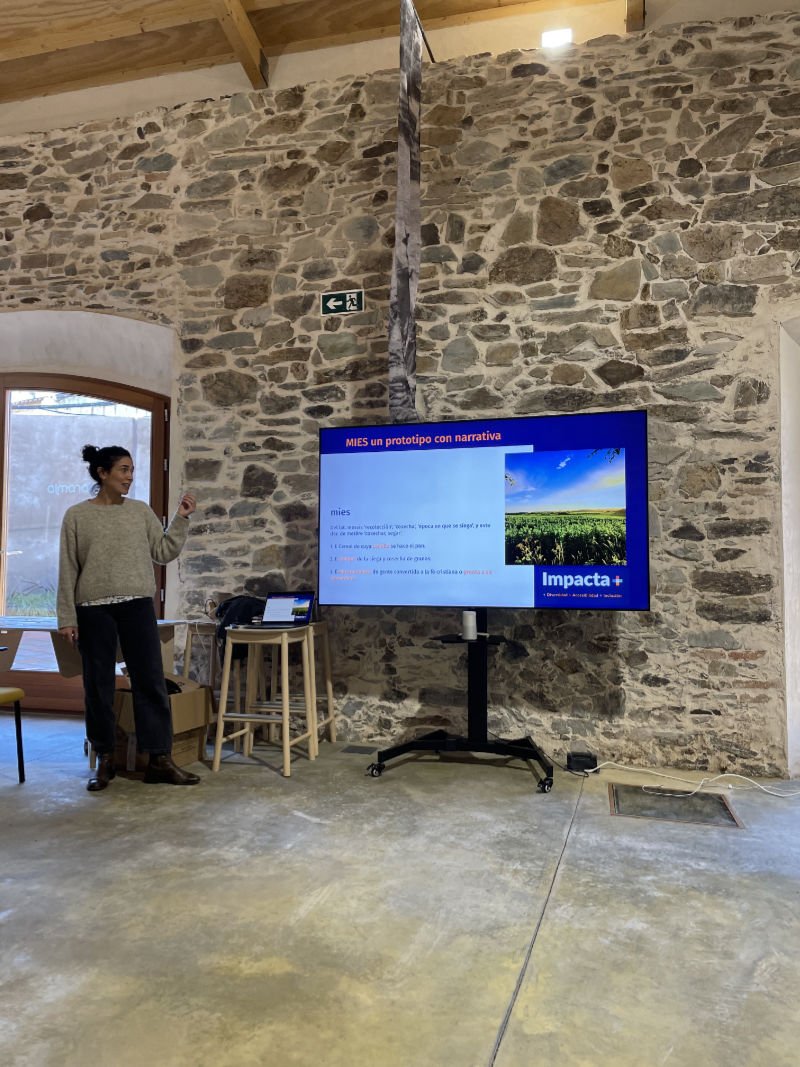
Laura, introducing us to the MIES program training
But—and if you know what we do at Pueblos Remotos you'll quickly understand—it wasn't the only one, nor the most important. In fact, I remember that one of the first things I asked Sofía was if she could tell me about some of the projects that were going to participate. So, she told me about some that I already knew (although I hadn't met them in person): Como una cabra , Apadrina un Olivo , Baku Barrikupel , and Gafasvan were projects that already sounded familiar, that I knew from The Break , or that had piqued my interest.
Another key pre-event moment was the coordination video call we had before traveling to the mountains of Huelva. When many people introduced themselves and presented their projects, a certain energy was already palpable; the feeling was positive, and the motivation to attend increased as the date approached.
Everything was analyzed (well, I'll admit here that it was only partially), discussed and planted so that we could go and reap the harvest.
Care (connected with people)
It's curious how the logistics of an event like this can bring four people together completely randomly, and that this can be the beginning of a short trip and interesting conversations.
Arroyomolinos de León is a beautiful town, but getting there from Tenerife takes several hours. The easiest option is to fly to Seville, but connections between Seville and the town are somewhat limited. Luckily, we were able to coordinate, and thanks to the kindness of Jacobo ( Regeneration Academy ), who offered to pick up Sira ( Apadrina un Olivo ), Milucho ( Fresco y del Mar ), and myself in Seville, we embarked on a car journey of just over an hour. During the drive, we started talking about the scenery, our projects, the areas we were coming from, and much more.
Arriving in the village was one of those experiences that I personally find amazing: putting a face, and a body, to the people behind each of the projects, because when you get there, the projects stop having just a commercial name, and start having personal names:
-
AlmaNatura: Conce, Juanjo, Israel, Sofía, Juanan and Elena
-
Terra da Auga: Laura, María, Ramón and Olatz
-
Muullhoa : Maria
-
Baku Barrikupel: Amaia and Jesús (her father)
-
Between Mushrooms : Nazareth (Naza) and Paul
-
Carqueixa : Román
-
Babel Nature : Daniel Calleja
-
Gafasvan: Daniel Paniagua
-
Like a goat: Maria and Cristina
I already introduced you to Jacobo, Sira and Milucho
Meeting in person also meant discovering AlmaNatura's 'base of operations': AlmaNatura LAB . It introduced us to a rich cultural event, full of symbolism, in what was (and is) the restoration of an old mill into a multifunctional space where all sorts of things happen: training sessions (like ours), exhibitions, plays, music concerts, hackathons , entrepreneurial experiences, and a thousand other adventures.
As a welcome to the village, we also enjoyed a typical Huelva dinner (yes, delicious ham!) at Bar Juanito, which is actually Paquito's place… Well, those are the kinds of charming village stories. The most important part of the dinner, once again, wasn't the food, but the conversations. We learned more about some of the projects, talked with Juanjo about the evolution of AlmaNatura, caught up on projects in rural Spain, and discussed all those topics that set the stage for some intense, but very productive, days.
Obviously, after dinner it was time to rest, because the next day we had a real workout in store


(Sunrise in Arroyomolinos de León: Day 1 (Left) vs. Day 2 (Right)
(*) As a prelude to the second day, I'll mention that I had a rather 'revealing' experience with a somewhat 'angry' pig when I went for my early morning run. Which I suppose is normal, if you see a guy all dressed in black with a headlamp running in front of your farm at 7:00 in the morning, hahaha.
The harvest (gathering what has been sown)
After a delicious breakfast together at the mill – those meeting points are so important – and after a few elbows to get the first coffee of the morning, we started a day full of intensity.
Much of the first day of the program consisted of two main things: identifying what our value is as a project and what our type of role is within it.
For this we used as a backdrop the aforementioned EXWEDO , from which we derived some very interesting models, such as the one you can see in the photo below (after forty years, I finally find out that I am a snake, imagine that)
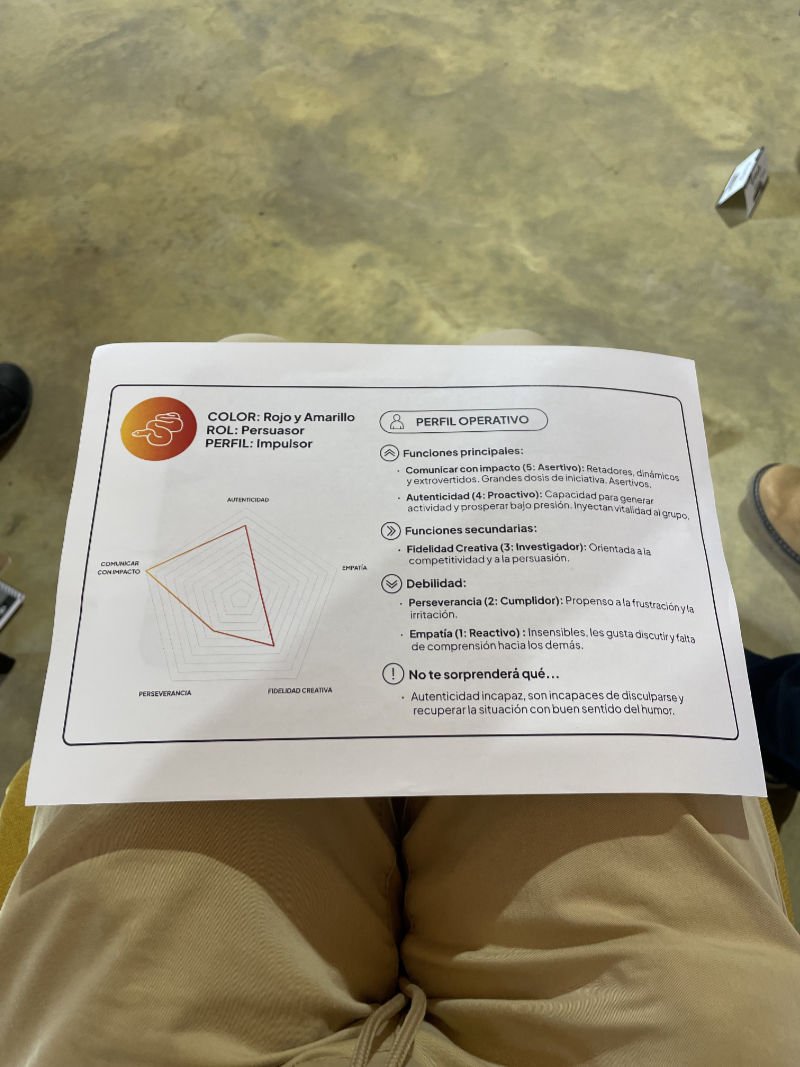
The moment it's proven that 'I am a snake'
These exercises were always accompanied by what I consider to be the best part of the work sessions: the debates and exchanges of impressions about how each person identifies and feels about their role, and above all about the values of their projects.
Those moments of exchange, of realizing what you do and above all why you do it, are some of the best things that can happen when you connect with other people.
Listen to how María Álvarez (Muullhoa) returned to the countryside at age 50 to start a business with her sister and two other women of similar ages, launching cosmetic products using cow's milk. Or how a father and daughter ( Jesús and Amaia, from Baku ) are working side by side to transform wine barrels into authentic works of art in the form of lamps.
Learn about projects like EntreSetas , founded by Naza and Pablo , who, in addition to selling this delicious food, have a fantastic project for forest reforestation. See the effort and dedication of Jacobo and his partners at Regeneration Academy , bringing regenerative agriculture education to a small village in the Murcian highlands: La Junquera.
To understand the years of work and effort of the fishermen and shellfish gatherers of the Costa da Morte in the words of Milucho (Fresco y del Mar). To see (and pay attention to the verb) in the mouth of Daniel Paniagua the passion that has led him to want to 'put glasses' on all the retirees of Castilla y León with Gafasvan .
Listen to the rich vocabulary that can emerge from understanding and calmly observing nature, as expressed in the words of Daniel Calleja and his Babel Nature . Feel the connection that binds Sira Apadrina un Olivo (Sponsor an Olive Tree) was born and resides .
Learn from Román (Carqueixa) how a livestock cooperative is managed and its importance in selling local, high-quality meat products from a village in Lugo. Understand the needs of women entrepreneurs in rural areas through the experiences of María and Cristina (Como una cabra) and all they are doing to support them.
And there, in the middle (and without diminishing our value) were we (well, me) the only one who raised his hand when they asked, "Projects that were born in the urban and help the rural from the urban?" The 'urbanites' of the place, that's right.

Moments of debate and conversation during training breaks
It was wonderful to be able to talk openly, to learn these stories, and then the next day (day two of training) to be able to shape what we wanted to convey in the closing videos with Merche and Laura. It was great to see how we shaped those 'pitches,' which in the end weren't really 'pitches' at all, but rather became more about 'how to passionately communicate the value of what we do and what we leave behind.'
And once again, the value of sitting in a courtyard to share, to tell a colleague in a close and honest way that what he is doing is VERY important, because he is surely changing the world and the lives of many people.
It was an opportunity to strip away labels, branding, and impactful concepts, to come down to earth and realize that the common thread we all share is leaving the world better than we found it. Each of us with our own perspective, our own reality, and our own way of understanding things.
And all of that happened because of something we call 'Connected Rurality' , because when you connect people, incredible things happen.
Well, and when you harvest the crop, it's time to eat it too
If I have to take away something from all this, apart from the harvest , it's the casual conversations and the 'fun' moments: that joke at the right time, those foosball games in the village bar (where, by the way, the locals gave us a good thrashing, hahaha), those chats before going to sleep in the room, talking about our places, in short, all that makes us human.
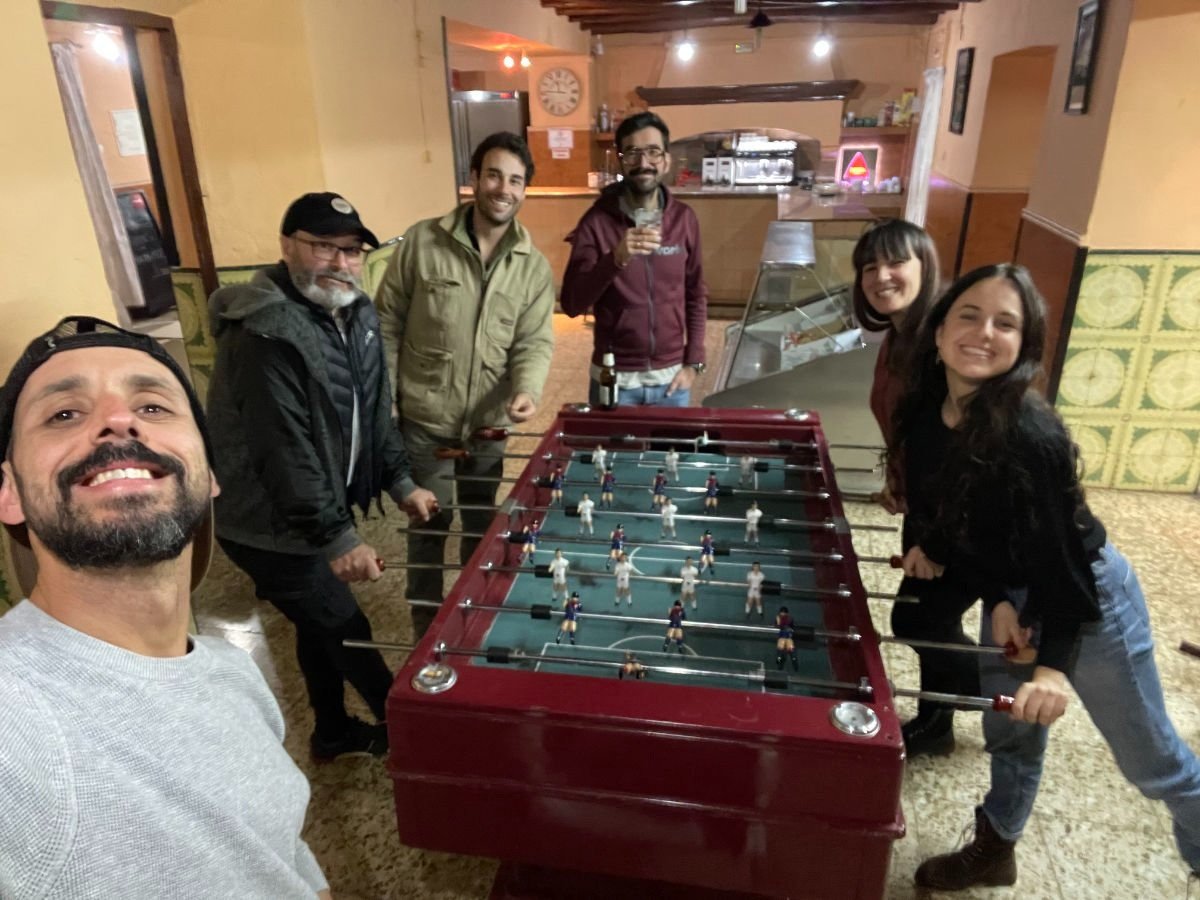
Foosball moments before going to sleep 😝
Before arriving, I was curious to know what Arroyomolinos de León would be like. What would that little town I'd heard so much about be like? And the truth is, being able to discover it in this setting was a real treat.
Now I wonder what many of the places I've been hearing about so much lately are like? Muros, Estela, La Junquera, Oliete, or the Sierra de la Culebra. And the answer I get is, "Who knows, maybe you'll visit them sooner than you think?"
Meanwhile, we must continue connecting, sharing what we've learned, and seeking moments of connection with each and every one of these projects. But above all, we must feel proud—proud of what we are building and of having projects that, above all, have a clear value in continuing to bring enthusiasm and drive to the rural world.